
St Patrick's Catholic Primary School
Geometry
Year 1
Position and direction
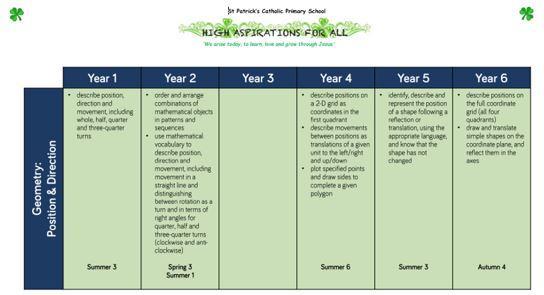
- Describe position, direction and movement, including whole, half, quarter and three quarter turns.
Properties of shapes
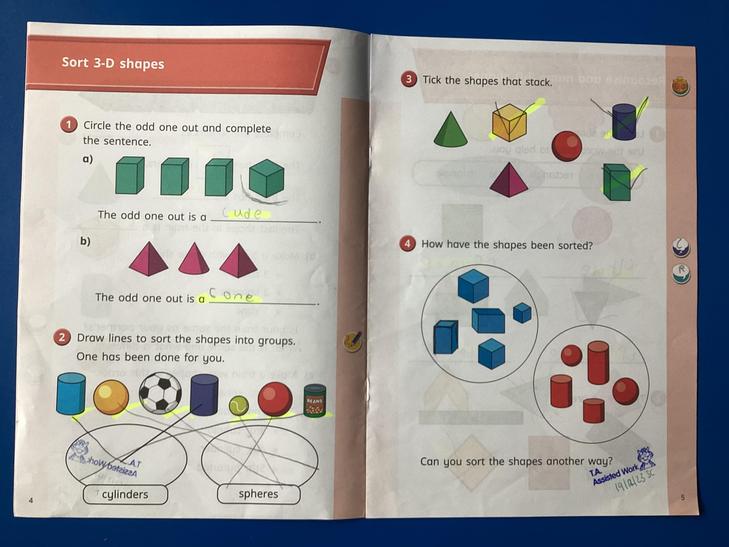
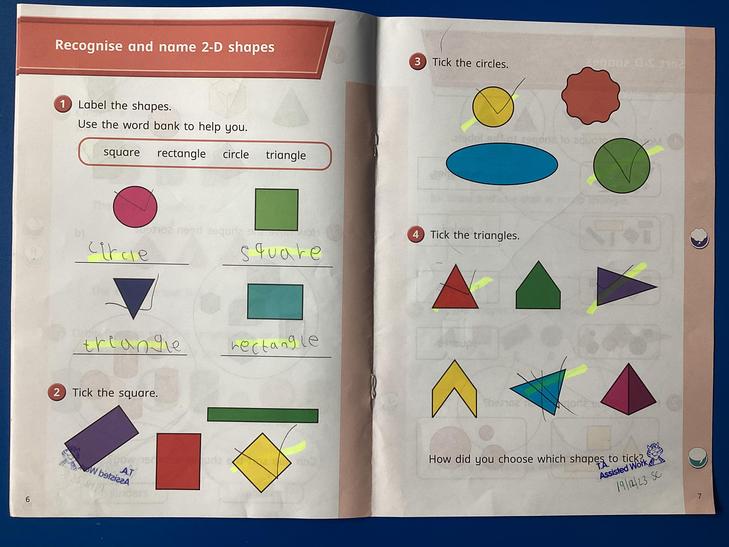
- Recognise and name common 2-D and 3-D shapes, including:
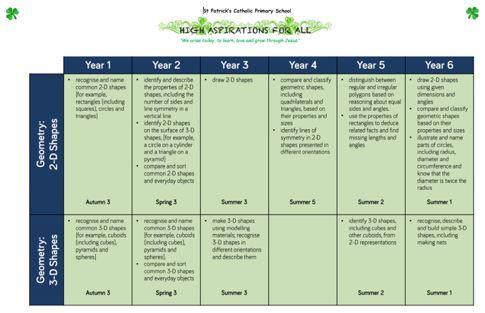
- 2-D shapes [for example, rectangles (including squares), circles and triangles]
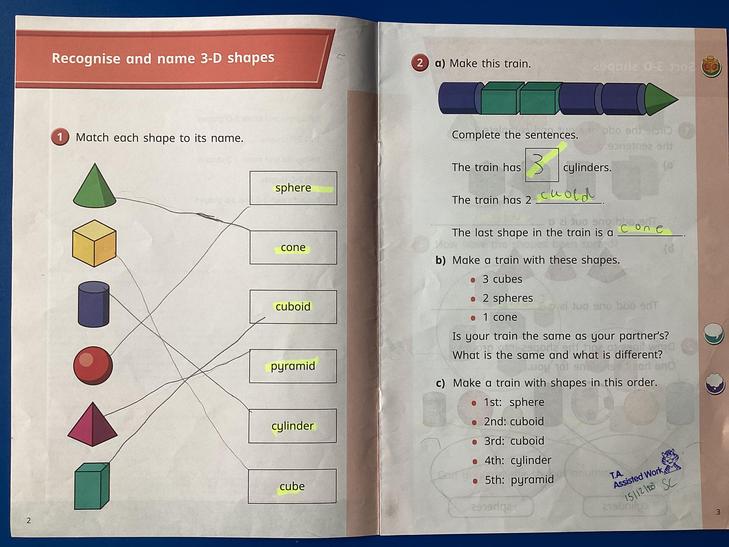
- 3-D shapes [for example, cuboids (including cubes), pyramids and spheres].
Year 2
Position and direction
- Order and arrange combinations of mathematical objects in patterns and sequences
- Use mathematical vocabulary to describe position, direction and movement, including movement in a straight line and distinguishing between rotation as a turn and in terms of right angles for quarter, half and three-quarter turns (clockwise and anticlockwise).
Properties of shapes
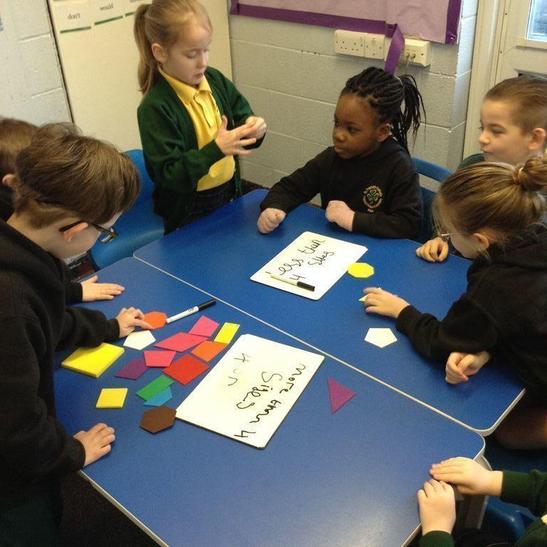
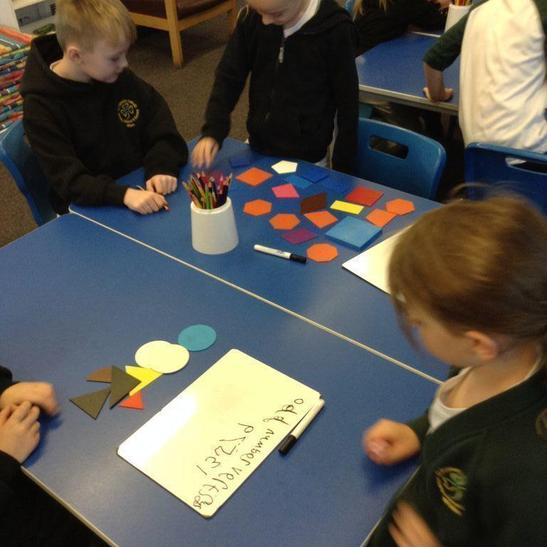
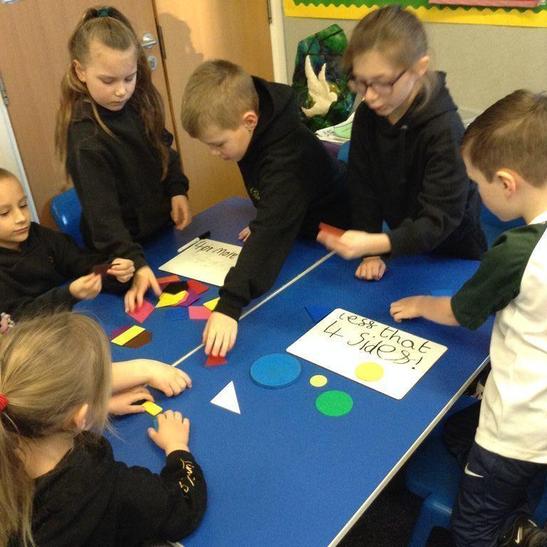
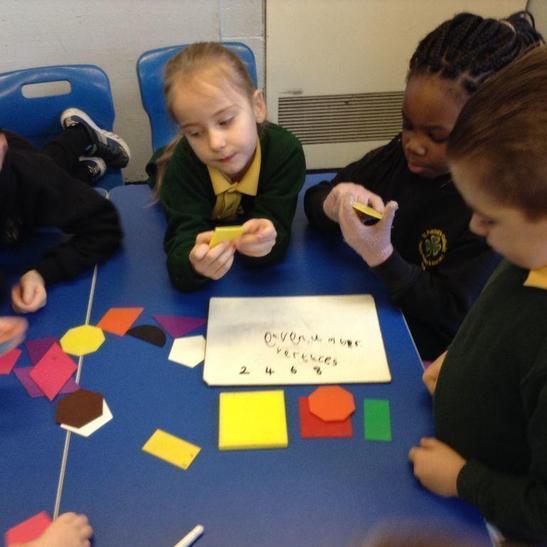
- Identify and describe the properties of 2-D shapes, including the number of sides and line symmetry in a vertical line
- Identify and describe the properties of 3-D shapes, including the number of edges, vertices and faces
- Identify 2-D shapes on the surface of 3-D shapes, [for example, a circle on a cylinder and a triangle on a pyramid]
- Compare and sort common 2-D and 3-D shapes and everyday objects.
Year 3
Properties of shapes
- Draw 2-D shapes and make 3-D shapes using modelling materials; recognise 3-D shapes in different orientations and describe them
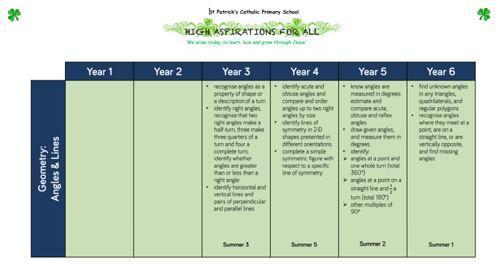
- Recognise angles as a property of shape or a description of a turn
- Identify right angles, recognise that two right angles make a half-turn, three make three quarters of a turn and four a complete turn; identify whether angles are greater than or less than a right angle
- Identify horizontal and vertical lines and pairs of perpendicular and parallel lines.
Year 4
Position and direction
- Describe positions on a 2-D grid as coordinates in the first quadrant
- Describe movements between positions as translations of a given unit to the left/right and up/down
- Plot specified points and draw sides to complete a given polygon.
Properties of shapes
- Compare and classify geometric shapes, including quadrilaterals and triangles, based on their properties and sizes.
- Identify acute and obtuse angles and compare and order angles up to two right angles by size.
- Identify lines of symmetry in 2-D shapes presented in different orientations.
- Complete a simple symmetric figure with respect to a specific line of symmetry.
Year 5
Position and direction
- Identify, describe and represent the position of a shape following a reflection or translation, using the appropriate language, and know that the shape has not changed.
Properties of shapes
- Identify 3-D shapes, including cubes and other cuboids, from 2-D representations
- Know angles are measured in degrees: estimate and compare acute, obtuse and reflex angles
- Draw given angles, and measure them in degrees (o )
- Identify:
- Angles at a point and one whole turn (total 360 degrees )
- Angles at a point on a straight line and 1/2 a turn (total 180 degrees )
- Other multiples of 90 degrees
- Use the properties of rectangles to deduce related facts and find missing lengths and angles
- Distinguish between regular and irregular polygons based on reasoning about equal sides and angles.
Year 6
Position and direction
- Describe positions on the full coordinate grid (all four quadrants)
- Draw and translate simple shapes on the coordinate plane, and reflect them in the axes.
Properties of shapes
- Draw 2-D shapes using given dimensions and angles
- Recognise, describe and build simple 3-D shapes, including making nets
- Compare and classify geometric shapes based on their properties and sizes and find unknown angles in any triangles, quadrilaterals, and regular polygons
- Illustrate and name parts of circles, including radius, diameter and circumference and know that the diameter is twice the radius
- Recognise angles where they meet at a point, are on a straight line, or are vertically opposite, and find missing angles.